
As part of a spring clean this weekend (and inspired by our recent acquisition of a Henry hoover, which frankly deserves a blog post all of its own) my husband and I decided it was high time to purge our cupboards and drawers of all unnecessary, useless, out of date or non-essential items. He took the ‘blue’ cupboards – the engine room, his ‘man drawer’, the terrifying space where household cleaners are kept, which resembles some sort of nuclear fallout zone – and I got the ‘pink’ ones – the entire kitchen, and my shoe drawer. The problem with living on a boat (well, one of) is that if it’s not condensating, it’s rusting, and if it’s doing one of those two things, anything in the near vicinity will be going mouldy. Seven pairs of algae-encrusted shoes later, I gave up on the footwear, and began to tackle the kitchen, where I found a similar story. The backs of my kitchen cupboards, it seems, have become a repository for all those foods that seemed like a good idea at the time, but have been consistently pushed aside in favour of the more traditional foodstuffs. So it is that the Japanese noodles, Italian breadsticks, oyster sauce and dried chickpeas are all crammed into one steadily going-off corner, hidden behind tins of baked beans, curry paste and (I hang my head in shame) strawberry Angel Delight. Dried spaghetti and packets of Crunchy Nut Cornflakes laugh mocklingly at the never-opened orzo rice and hesitantly-sniffed-at organic muesli. It seems, despite my good intentions, and flashes of inspiration whilst perusing the ‘speciality ingredients’ aisle in the local Waitrose, the beluga preserved lemons – purchased for some fervently-imagined Moroccan tagine – always lose the battle against the tinned tomatoes for the infinitely easier spag bol. Even our tastes in curry never waver – if I buy Madras, Balti and Rogan Josh, the Madras will be long gone and a replacement bought before barely a tablespoon has been taken from the others.
But it appears this is not just a lazy-Davies problem, but one experienced by many. Scientists have named it the ‘Diversification bias’, whereby our imaginations tell us that we want to try lots of different things, but in reality our palates and instincts favour just a few. If we go and buy our lunch on a daily basis we will buy an apple or a banana, and maybe a cherry yoghurt. If we buy all our weekly shopping in one hit, we’ll buy apples, bananas, oranges and a pineapple, a multi-pack of differently flavoured yoghurts and some cereal bars. And at the end of the week we’ll have left some shrivelled oranges, a slightly-squidgy pineapple, three fruits of the forest yoghurts and the cereal bars will have lost themselves down the back of the sofa. And we’ll berate ourselves for being so unimaginative, chuck out the pineapple, and repeat the process the following week.
I have noticed this quite a bit, particularly when my local supermarket goes on one of its ‘buy three and get seven free’ jollies (it generally coincides with a junior member of the purchasing department getting over-excited about asparagus), and I feel obliged to buy an assortment of fruit and vegetables that I don’t want or need because it would be stupid not to. Take herbs, for example. My husband and I love coriander, and will put it in virtually anything, given the opportunity and minimal quantities of alcohol. (Coriander mojito anyone?) On a BOGOF offer, I should just get two packs of coriander. But it seems so… samey. So I’ll buy a pack of dill or tarragon instead, and then watch in dismay as the weeks pass and what was once a heady, aromatic fluffy-leaved potentially-Michelin-worthy fish accompaniment morphs into a heady, aromatic contender for the Turner Prize, its sloopy pondy barely-bagged gunk rendering the salad drawer in the fridge a no-go zone.
My fruit bowl at this very moment contains a pineapple (starting to look a little sad) and a bunch of cherry tomatoes, which aren’t actually cherry tomatoes but have some fancy name that encouraged Tesco to add an extra £2 per kilo, and me to buy them, and which whilst very nice just aren’t an apple or a banana. And they’re only in the fruit bowl because I had to throw the salad drawer out.
So why do we insist on doing this to ourselves? Why can’t we accept that we like what we like, and that if we are quite content doing the same thing every day – going to work, watching our favourite TV programmes, supporting the same sports teams – why can’t we apply the same rule to our eating habits? We can still be imaginative and try something new, without attempting a culinary round-the-world trip in seven days, taking in paella by way of sushi with a fajita inbetween. Although there are over 30,000 types of vegetable and even more fruits, we don’t need to try and cram them all on to one grocery list. Or indeed, to the landfill where they will inevitably end up (by way of industrial-strength gloves and a peg on the nose, and copious quantities of household cleaners to tackle the stains left behind). Speaking of which, I must see if my husband has unearthed the max-strength fungicide from his cupboard yet; I seem to recall buying some shiitake mushrooms for Chinese New Year…

I’ve been thinking a lot about babies recently. Don’t get alarmed, I have no intention of breeding myself, in fact, quite the opposite. Now that Our father is pretty much as finished as it will ever be, I’ve been thinking about my next project, and whilst I’m keen to go back to Creepers, I think I need to immerse myself in genre-appropriate culture first – the works of Stephen King, some supernatural thrillers, maybe hang around the back alleys of Littleport on a Friday night – and so, prior to that, and to ease me back into solid writing, which I haven’t done in quite some time, I thought a short film might be fun. I’d like to know more about the film making process, to find out what exactly the director, producer, editor etc. do all day, and to see the creative process behind the actual production of a film. I know my bit inside out, but how does a film translate from 110 wine-and-tear-soaked pages to an hour and a half on the big screen? Perhaps making a short film myself, with the collaboration of others of a similar disposition, would enable me to find out – and make me a better writer.
So what’s this got to do with babies? I’m not in some whimsical mood, pondering on the ‘gestation’ of a new project or anything like that – rather, my idea for a short film centres around babies, or the lack of them. Being one of those suspicious characters that is an educated woman in her mid thirties, who has been married nearly a decade and has a steady job, yet Does Not Have Children (I can hear the Daily Mailers recoil in horror and indignation), I often get asked how and why this particularly sad state of affairs has transpired. “Just keep trying”, I’m advised with a comforting pat on the arm by well-meaning old ladies who refuse to believe that I’m not. “Your husband will come round eventually” sympathise others who think it’s all my other half’s fault, and that I actually spend every night begging and pleading him to get me pregnant. Of those who do actually listen, and understand that right now, neither my husband nor I want children in our lives, pretty much all still give us reassuring pats on the back and say, “I’m sure you’ll change your mind in time”.
This ‘in time’ business particularly irks me, that I’m in any way dangerously close to my available ‘breeding window’ and that if I don’t get a move on my womb will shortly close its gate like some particularly fastidious budget airline. A few years ago the newspapers chose to take up many hundreds of column inches of their Sunday supplements with cautionary tales of the women whose ‘prosperous careers’ caused them to leave it too late to breed, or those who struggled to get pregnant even after years of ‘distressing’ IVF. Then the Government started to pay them to print something else – I think cautionary tales of foolish people who left it too late to plan for their retirement.
The general message was that if you left it beyond 35 to push out some generational tax-paying fodder you were recklessly irresponsible, would regret it later, and don’t come crying to the NHS when your unfulfilling career fails to make up for the gaping hole left in your life by the absence of offspring. It made me ggrrhhh.
Anyway, what my upcoming short film and this diatribe about the Government’s policy on childless women have to do with each other is that the film will focus on a group of couples who have decided, for one reason or another, that breeding isn’t for them, and such is the ostracism that they’ve experienced from their family and friends that they’ve joined together and formed a club – the MADWACS (Married And Don’t Want Any Children). These people consist of a bunch of 30- and 40-something couples who prefer to spend their time going on nice holidays and buying furniture of a fabric that won’t be imperiled every time a toddler comes within spitting distance, as opposed to wiping snotty noses, spending their entire pay cheques on car seats, and centering every topic of conversation around the latest adventures of Peppa Pig.
This group of intelligent, educated, middle-class and reasonably well-off couples refuse to believe that, come a certain age and career level, all of their worldly experience and possessions must be pooled and swapped for two decades of vomit, back-chat and trips to Lego Land. The plot will of course throw many obstacles their way – including, inevitably, a baby – but its overall message will be that two people can constitute a ‘family’ unit without need for infants, and that their contribution to society is just as valid as those who require a five-door saloon and bulk orders of SMA baby formula.
Maybe I’m writing a film for myself here, and no one else will agree – but I doubt it. In my workplace there is a whole department of people who are married or in a steady relationship, are progressing into their 30s and see no place for children in their lives. We’re a mixture of males and females, and, although I can only speak for myself here, I’m confident none are feeling pressure from their other halves to change. We’re basically NIMBYs, but from the perspective of the womb. The fact that the world requires propagation is absolutely fine with me – I’d just rather you did it elsewhere; I’m rather fond of my view.

Watching Skunk Anansie play at the Cambridge Corn Exchange last night, I felt like I’d been transported back through time to a more carefree age in which, aged sixteen and supremely confident in my Bluetones skinny t shirt and an ambition to become the editor of the NME, I would on an almost weekly basis rock up to the Corn Exchange or Junction and happily shell out my seven quid to see whatever band happened to be playing that week. Such was my enthusiasm that we were always there early, supporting the support, chugging our snakebite and blacks and eagerly craning our necks to the stage for a glimpse of our heroes. Now, older, maybe a little wiser, and looking suspiciously like those ‘grannies’ we used to take the piss out of for daring to abandon their knitting and slippers for live music, my friend and I had a slightly different, yet refreshingly nostalgic experience last night, eschewing the support for beer and pizza at the pub next door, and the skinny band shirt for an altogether more practical ensemble for the weather.
Skin, now in her late forties, is as cool as I remember, and the admiration, envy and awe that I felt for her then assaulted me the moment she skipped on stage in her feathers and Mohican and distinctive shouty growl. We’re worlds apart but her lyrics resonated with me last night in a way they couldn’t possibly have done as a fresh faced teenager 18 years ago, who knew nothing about heartache, betrayal and loss, nor even the basic feminist and political rights she was fighting for in her music.
It’s well known that sounds or smells can trigger a memory, and this was most definitely the case last night as songs such as Hedonism, Weak and I can dream triggered such vivid flashbacks as to completely lift me from my day-to-day life, and transport me back to my youth in the space of two glorious hours. When Skin scrambled her way over the barrier and into the delighted audience, we rushed to her side and swooned at her charm, utterly respectful of her fragility and the implied trust she awarded everyone in the room by taking such a daring move.
And man, I had no idea how much I needed a good shout! In my normal, staid and placid life (in which, regrettably, I am not the editor of the NME, nor even a subscriber now), I am polite and calm, allowing injustice and insult to wash over me with little comment, and needed an opportunity to get it all out – the anger, disillusion, resentment and pain – in the space of a three minute song amidst a bunch of sweaty rock fans, all doing the same thing. For a couple of hours I felt completely free, comfortable in my own skin, relishing and rejoicing in a shared passion for awesome music. I felt seventeen again.

This afternoon, commuting home on a busy train from London, sat in the aisle due to a lack of seats, I reflected ruefully that today is International Women’s Day – a day in which the ‘political and social awareness of the struggles of women worldwide are brought out and examined in a hopeful manner’. Hmm.
What for exactly? And in whose world? The Day tends to have most significance in ‘developing’ countries, where it is treated as a national holiday, and political and cultural event, rather than – in the UK and I suspect other ‘Western’ countries – as mildly-derided, uneventful and insignificant – just another ‘Day’ that no one cares about. In the papers today were plenty of columns from women talking about feminism, women’s rights and achievements, and there’ll no doubt be a laudable list of women who have done well in the past 12 months – bring on the usual roll call of Oprah, JK Rowling, Aung San Suu Kyi, maybe Adele – so that we can all applaud and congratulate ourselves on being a democratic, equal and fair society.
If I sound sceptical it’s because I find it difficult to keep a tone of derision from my voice when talking about such events. Particularly when, upon Googling International Women’s Day, to see what it was really about, I found there is another such Day – International Men’s Day – which occurs on 19 November.
Are we really in such a desperate state that we feel the need to not only celebrate a pointless initiative, but also counteract it (maybe even countermand it) by introducing another Day to deflect potential allegations of favouritism and sexism?
International Women’s Day originated in1909 in the United States (International Men’s Day was founded in 1999) but has only recently received much attention in the British press. Its themes tend to centre around issues most common and pressing to the Third World – poverty, hunger, trafficking, forced marriage and cultural practices – although the theme this year, perhaps to garner more support from the modernised countries, is ‘A promise is a promise: Time for action to end violence against women’. The Day is of course used as a political tool – Barack Obama used it in his last campaign, and no doubt David Cameron will shoehorn it into some sort of initiative to back women on the Board and demonstrate the progress the UK is making towards equality (FYI, not much – Equal Pay Day on 27 February highlighted that women in the EU had to work 59 extra days in order to attain the same average salary as their male counterparts in 2012).
I’ve been lucky in my career to date to have experienced very little discrimination based upon my sex. Reading ‘A thousand reasons’, a website set up by British novelist, Linda Grant, following 2012’s IWD, during which she received a barrage of tweets from women who believed they had been on the receiving end of sexism throughout their working and personal lives, I struggled to find much common ground. After I got married, I felt some indignation in having my bank statements addressed solely to my husband for a joint account. When cruising around the waterways of France on our converted barge, I got used to the lock keepers continually addressing my husband – as ‘Capitaine’ of the boat – as to which way we were heading, despite me being the only one with any command of the language. And my experience of having a bisexual name means I rarely notice now when letters and emails are addressed to ‘Mr Davies’.
If anything, I’ve more often been on the receiving end of positive discrimination – a couple of weeks ago a man on this exact same train very gallantly gave up his seat for me, under the impression that I was pregnant (I have since thrown away the clothes I was wearing that day).
In general, I think both men and women are of the opinion that, certainly at work and in most areas of our lives, we’re equal, and strive to promote fairness and equality of opportunity. However, we’re so concerned about ensuring equality to all (supporting women, offering flexible working and incentives to progress careers) that we feel the need to also make a (however tokenistic) effort to ensure all measures are ‘fair’ and equal – thus the Government’s recent focus on parental (as opposed to maternity) leave, flexible working for all, regardless of parental status and the age of the child, and scrapping the tradition of reduced car insurance premiums for women – despite sheer facts demonstrating they cost less to insure as they are more careful drivers – for fear of discrimination.
It is against this fearful background that my scepticism for such initiatives as International Women’s Day proliferates. If we cannot accept that one sex gets a rougher deal than another (I can just hear the men this year decrying that they suffer from violence too), then we will never make progress towards a more equal society. Equally, if we continue to bleat on that one or other sex is unfairly undermined, overlooked and unrepresented, the other will always feel threatened and targeted for attack, and will cling to their perceived sense of power, or feel guilty and uncomfortable about it.
What I would prefer to celebrate is an International Equality Day, whereby women are celebrated as women, men as men, parents as parents, employees as employees. Leaders are no more impressive if they’re female; full-time parents are no more (or less) honourable if they’re male. Doctors are doctors, nurses are nurses. Let’s value who we are for what we do, rather than the body in which we do it. And, while we’re at it, demand more seats on trains.
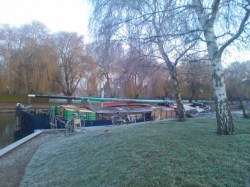
This weekend, after a series of mishaps, bad luck, and petty-minded bureaucracy, I posed the following challenge on my Facebook page: “If anyone can give me a good reason to live on a boat, they can have my boat.”
The replies I received were split between two camps: those who thought living on a boat must be absolutely lovely; and those who had actually done it.
My friend Derek said “There are two good days when you have a boat – the day you buy it and the day you sell it!” – and this from a man who has a brand new made-to-measure no expense spared fibreglass motor cruiser, as opposed to a 107 year old leaky-from-all-ends steel Dutch barge that you can actually watch rust.
The fact is, living on a boat isn’t easy. It’s fun, it’s different, it’s sometimes romantic and adventurous – but there are no easy days. In the winter you worry about the engine seizing, having no water for weeks because the standpipes are frozen, and breathing in so much coal dust you could set off the carbon monoxide alarm by exhaling too heavily. In the summer you feel obliged to go everywhere by boat, and thus have to set off for a relaxing pub lunch at seven in the morning. Friends with small children must be bundled into oversized lifejackets and yelled at not to touch anything every nanosecond. Stray teenagers like to use the roof as a parkbench/dustbin/public toilet, sometimes all at the same time. And, throughout the year, everything condensates.
But all of this can be coped with. The problem we are currently experiencing is the 60 square metres of water that the boat floats upon. We don’t own it, and every day it’s subject to change – upon the whim of the current landowner, council or governing body. Regulations change, opinions differ, someone gets out of bed the wrong side and suddenly we’re homeless. Unless you’re lucky – and rich – enough to own the piece of land, and thus water, upon or next to which your boat resides, your life as a liveaboard is insecure and uncertain, and the actions of a few can dictate the consequences for the many. This winter we were moved on from the mooring we had settled ourselves into – and spent money on making homely – because the minority were causing trouble. We are now forced to pay double the amount for a less hospitable and inconvenient berth, during a hard winter where no other options are available. The ‘romantic’ vision of the carefree wandering nomad, where Johnny Depp sits on the front deck whittling crap out of wood and looking pretty, doesn’t really apply.
The angry locals, incensed at both the Godless hussy making chocolate and the long-haired pikie intent on robbing them, are however, very real, and the indignation and narrow-mindedness through which some people view boat-dwellers as a community is sometimes quite shocking. “You don’t pay council tax do you?” was a question I was greeted with as I emerged from my boat one day last week. “Good morning,” was my reply.
I can’t entirely blame them. Throughout history ‘gypsies’ of various guises have been held in contempt, suspicion and derision, their name dragged through the mud, cast under the same banner as freeloaders, thieves and general ne’er do wells. Programmes such as ‘My big fat gypsy wedding’ serve only to strengthen the stereotype and heighten the fear, so that the NIMBYs are well aware of and fully prepared for the consequences of a new ‘traveller’ appearing in their midst. We live off benefits, cause trouble, cost the tax payer money, don’t contribute to society, and are not to be trusted.
We also have children, cars, mortgages, recycling bins, pets, responsible jobs, ill parents, hopes, fears, and dreams. And the possibility that, depending upon their mood, or pressure applied from an increasingly frightened council, we might not have a home to go to next week. So whilst living on a boat is lovely, it’s not quite the romantic, easy life you may envisage when walking past the narrowboats with their merrily smoking chimneys on a winter’s evening, or the cheap and unregulated alternative to bricks and mortar that might be suggested from the washing lines strung from tiller to deck. We’re not here to threaten your way of life; and we hope you won’t try and threaten ours.

Three and a half years ago, after finishing a normal day at work, I said cheerio to my manager and went home for the weekend. I didn’t see her again until yesterday. For the past 40 months she has been in and out (but mostly in) a mental health care facility, unable or unwilling to see or communicate with friends, colleagues and family. Very few of her former colleagues openly acknowledge the fact she is no longer at work, and I suspect quite a few don’t even remember why she ever left. Mental health is the last social stigma in the workplace – people accept when staff go off on maternity leave and don’t return; they understand disability or access issues that mean their colleagues can’t attend the office. They even forgive employees who are off on long-term sick for physical reasons, despite misgivings about malingering.
But mental health is a different ball game. No one wants to talk about it – it’s embarrassing, and something that shouldn’t be discussed. When my manager left, no one knew where she had gone, why she had left, and if she would be back. There were whispers in the staffroom, and the whole issue was shrouded in secrecy. Even after all this time, no one really talks about it openly. Her colleagues and friends know she is safe, and that I go to visit, and whilst they sign cards and send their love, the whole issue is still very much ‘out of sight, out of mind’. I’m not blaming them – it’s hard work reaching out to someone who can’t be reached. To begin with, I tried to keep in touch as much as possible – I would write, send texts, emails, whatever I could. She didn’t like to talk over the phone, or accept visitors, because she found it too upsetting. Then, after courses of ECT treatment, she found it harder still, and disappeared into a self-imposed bubble for quite some time.
I got to the point where I had almost given up trying to reach out. People told me (in a well-meaning, protective way) that I shouldn’t keep on trying to help when she gave nothing back – she was a ‘lost cause’ or ‘too far gone’. The problem had gone away, her name never entered the conversation.
But then a friend who had gone through a similar experience urged me to carry on trying to connect. It was the people who didn’t give up, he said, that were the ones who got through, and the ones who made a difference.
And yesterday, finally, I went to see her for the first time since I walked out the office door on a sunny afternoon in September, back in 2008. It was in very different surroundings – Spartan rooms with locks on both doors, echoes of shouts and doors banging in the distance.
And she was a very different person – frightened, anxious, unsure. But still, under all that, the same person I remembered from the time we worked together – a fun-loving, intelligent and capable woman, who had finally regained enough confidence and courage to accept the fact that people loved her and wanted to help.
I can’t say that I walked out of that door 45 minutes later with any feelings of euphoria or hope, but it’s the first step on the path for us both – her hopefully to recovery and full integration with her past life, and me towards being more open and positive about the issue of mental health; talking about it with people, and encouraging others to get in touch and not be afraid of upsetting someone or being inappropriate. We’re just people, and people have issues – all of us. Asking for and accepting help isn’t a weakness – it’s actually the most courageous thing you can do.
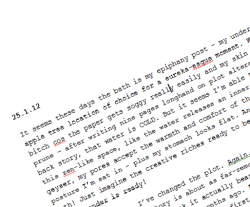
It seems these days the bath is my epiphany post – my under-the-apple tree location of choice for a eureka-esque moment. Which is a bitch cos the paper gets soggy really easily and my skin starts to prune – after writing nine pages longhand on plot alterations and back story, that water is COLD. But it seems I’m able to think in this zen-like space, like the water releases an inner creative geyser, my pores accept the warmth and comfort of the womb-like posture I’m sat in – plus my stomach looks flat. And this in a hip bath! Just imagine the creative riches ready to be plumbed when the double-ender is ready!
Anyway, in short, I’ve changed the plot. Again. Possibly I’ve lost the plot – this new story is about as far-removed from the first half of Draft 1 that I think it actually bears NO relation to that script I started just 12 short months ago. Possibly this is a good thing – I’m pretty sure 99% of those first few pages was crap – but also I’m a little sad that the creative roots that sprouted back then have failed to shoot leaves in this version. Also, it was a shit load of work I lost. Dumped. Dozens of characters killed. Already having suffered the indignity of having their names, sexes, and sexualities changed (for heaven’s sake!), they were obliterated off the page as easy as gurgle! Down the plughole.
What started off as a bunch of people cheating on each other morphed into a film about people wanting something they couldn’t have – it frolicked briefly as a Biblical treatise on the ethics of coveting – and then transmogrified into a study on parental scars, a psychologically telling (Freud would LOVE it) tirade on how a father takes over his sons’ lives even when he isn’t there (sound familiar? Tssh), and has now – unbelievably! – become a film on a father taking over. He’s commandeered my damn script! This guy, who was originally called Mark, and was the father to a little girl, a step father to an adolescent boy (both characters now sadly FLUSHED, sorry), and uncle to Malik and Salim, is now the twins (renamed) DAD, married to his once-sister, and a rock star instead of a chartered surveyor. How the frick did that happen??? I worry for my mind.
It now seems somewhat surreal that I finished the original script. At one point in my life I had 138 pages of first draft. I now have nine pages of illegible, slightly damp, synopsis, a handful of good scenes I can maybe re-use, and a 500-word outline due to be submitted on Friday that’s 795 words long. And isn’t very good. I do think I’m going in the right direction, but the route has changed so much I’ve lost my map. And do I want to get to that particular destination anyway?
I’m pretty sure I can keep this metaphor going a bit longer but think it’s better to kill it. I need to keep ploughing on, remembering the feelings of excitement I get when an idea starts working, and wait for the next one to rear its head. Keep writing crap in search of the diamonds.
I’m really glad I asked for feedback. Most people have been very kind – but it’s those who have been cruel who have been of use. I need my ego deflating a little, I need to have the piss taken out of my work. It’s far easier to cope with than that slightly panicked look people get in their eye when they’re struggling to come up with something good to say. And if an idea doesn’t work, it doesn’t work. No one liked the battle of the bands – and that was a new thing. Something I thought would work really well – no one bought it. They all asked where the mother was, and no one liked the main character. Or his name. They latched onto things I thought were trivial, and missed the relevant stuff. And I need to listen to everything they say, even (especially!) if I don’t agree, and see my story objectively. And subjectively – they’re an audience with opinions, and they’re all right.
Gonna have to take another bath.
 alexjanedavies